Character Development

[size=150]Stephan's Vis[/size]

Because he didn't spend much vis at all, I've decided to go with the option of getting 5 vis a year and paying for what I spent. Here's what I get for totals.

(5 pawns/year)(22 years) = 110 vis

[table][tr][td]110 vis[/td] [td]STARTING VIS[/td][/tr]
[tr][td]-16 vis[/td] [td](to open talisman)[/td][/tr]
[tr][td]-8 vis[/td] [td](for powers in talisman)[/td][/tr]
[tr][td]-7 vis[/td] [td](for LR)[/td][/tr]
[tr][td]– 9 vis[/td] [td](binding familiar)[/td][/tr]
[tr][td]–4 vis[/td] [td](instilling powers into familiar)[/td][/tr]
[tr][td]66 vis[/td] [td]ENDING VIS[/td][/tr][/table]
In addition, there's nine years of personal vis source = 9*4 = 36 Co.

Wow, that's a lot of vis. If anyone has any suggestions as to what I might have spent some on, I'd be happy to hear.

I was thinking that maybe some of it might have been turned into cash to buy his canal/river boat. Is there anything else he could buy with vis? I mean, I'd like to start with some vis. But I don't want to break the economy.

Meta game question. Where are the materials which magi create magical items from assumed to be sourced from?

e.g. the somewhat odd material which are in talismans, items, etc are not lying around. Is it assumed that a magi can acquire most of what they need as part of a seasonal lab activity?

i.e. mercury, magnets, large copper shod staves, custom made gear? weapons of quality,

I'm assuming that part of lab upkeep is obtaining a variety of magical materials. This presumably includes reasonably common items, and probably a few rare ones, though nothing too out there or expensive. I can't expect to have a pile of diamonds or powdered dragon's tooth lying around. But some beech wood to make a staff, iron and brass to cap the ends, a magnet, a few drops of mercury in a glass ampule, and a piece of quartz seem like the sorts of materials that could be either be expected to be found in a lab or would be easy (and cheap enough) to acquire.

As for the actual construction of a talisman I assume that some is done by skilled craftsmen in the covenant. For example, capping one end of a staff in lead and making a brass fitting on the other end to hold a piece of quartz crystal seems like the sort of thing a blacksmith could do. Embedding a magnet and an ampule of mercury in the staff would require some minor woodworking, but nothing too sophisticated. Carving arcane symbols on the staff - probably the magus.

The core rulebook notes the following in its Laboratory chapter:

[hr][/hr]
[size=150]Shape and Material[/size]

The first thing you must do for any magical device is choose the physical shape of the item you wish to enchant — both the shape of the item and the item’s material. Look at the Shape and Material Bonuses table to see what sorts of items have bonuses relevant to the types of enchantments you wish to place. You should also pay attention to mundane criteria as well as magical. Enchanting a gold sword might appeal to you, but such an item would be too heavy and soft to use in combat. And while a diamond might be perfect for your ring, do you have a diamond? You might have to go out into the dangerous world to find your materials, especially if your covenant is poor.

Before you begin the process of enchantment, you must acquire the item you will enchant, and note its size and composition.

[hr][/hr]
From this I take it that a lot depends on how poor your covenant is (i.e., how much they can afford to spend on upkeep for your lab). You might have to adventure to get a diamond. But it seems like getting a stash of brass would be relatively straightforward.

Then I looked at the Covenants book. It has this to say about lab equipment:

[hr][/hr]
[size=150]Laboratory Equipment[/size]

There are several types of mundane equipment that are found in a standard laboratory. Heating sources — including candles, lamps, and braziers — are used when the maga needs to distill or calcine a compound. Receptacles such as pots, bowls, and crucibles may be made from pottery, stone, or metal. Storage containers are also a must, and include bags, baskets, boxes, jars, and sealed pots. Other basic equipment includes spatulas or spoons to measure out and stir compounds, weighing scales, tongs to move heated containers, and tables. Basic ingredients include sand; charcoal; a small quantity of silver; numerous liquids including water, distilled alcohol (used as a solvent), and oil; as well as various powders and pastes.

(emphasis mine)

[hr][/hr]
Covenants also has the following virtues and flaws for labs:

[hr][/hr]
Extensive Stores: The lab’s large stores mean that it can withstand shortages better. In the case of a lack of funds, the lab can last six seasons before a Flaw must be selected to lower the Upkeep, instead of the usual two. However, a one-time payment of a number of pounds equal to the lab’s yearly maintenance cost must be made when this Virtue is added, to stock up the stores in the first place. Vis and dangerous materials can also be stored more safely. +2 Safety.

Precious Ingredients: The lab is supplied with more expensive ingredients than a typical covenant can afford. +1 General Quality, +2 Upkeep; +1 Longevity Rituals.

Priceless Ingredients: The lab is supplied with the kind of things that most people can only dream of, such as copious quantities of gold and gems. +2 General Quality, +4 Upkeep; +2 Longevity Rituals.

Lousy Ingredients: The lab is supplied with dirty, impure, or poor-quality ingredients. It does not take a season to remove this Flaw, if sufficient funds are available to increase the Upkeep. –1 General Quality, –1 Upkeep.

Missing Ingredients*: Due to a lack of certain ingredients, lab work involving either one specific Technique or two specific Forms is severely hampered — relevant Lab Totals are halved. For example, the lab might contain no silver, in which case Terram and Vim Lab Totals are halved. It does not take a season to remove this Flaw, if sufficient funds are available to increase the Upkeep. –1 Upkeep.

Faerie Ingredients: Some of the lab’s stores are supplied by faeries, and have beneficial (if sometimes unpredictable) properties. For example, faerie silver is used in place of real silver. +1 General Quality, -1 Upkeep, +1 Warping; +1 Experimentation, 1 point on an appropriate Specialization.

Inexhaustible Supplies: The lab is blessed with magically replenishing ingredients and consumables, which never run out. –3 Upkeep, +1 Warping.

[hr][/hr]
It never specifically says what a basic lab has. But based on these flaws and virtues, I think we can assume that a regular lab has more than Lousy or Missing Ingredients, but less than Precious Ingredients. Where does the line fall with respect to various ingredients? Well, that's ultimately up to the SG. But I think it's likely to be pretty obvious on its face what is "too much" to expect to be in a lab and what's okay.

In any case, those are my thoughts,
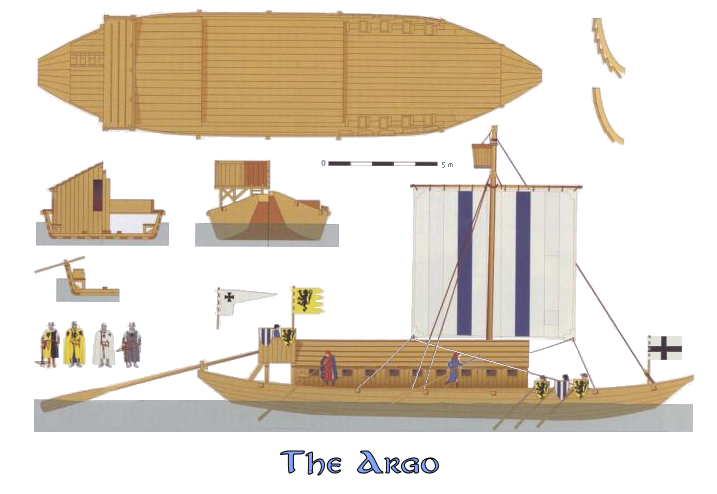
Here's an edited picture of the Argo:

It's something I'd prefer to handwave, unless the materials in question are either rare or of unusually high quality.

Scott

OK, looks fine to me, as long as you've made sure to include the appropriate size modifiers in spells meant to affect it.

Scott

Yup, the size mods are there. +1 makes it big enough to carry 50 Load, +2 makes it big enough to carry 500 Load, and +3 makes it big enough to carry 5000 Load.

I assume most materials are just bought in as part of the supplies - there may be a bit of a delay if you want something particularly odd, or in extreme cases you might have to go and get it yourself - but that's more likely to happen if you decide you really need the heart of a dragon as opposed to a rare type of wood.

Almost any mage would leap at the chance to buy vis with silver. I have no idea how to even approximate the exchange, but it would buy a boat, np.

I like boats. I (obviously) like history, and so nautical history. I've done this drill w/ other characters, a flying boat. A couple things...

The boat almost has to be sea-worthy if you're going to enter a harbor - it has to be seen sailing in or questions will arise from one party or another - often there is a tax to use the harbor, etc. - "... and when did you arrive?..." More, while you ~might~ be able to fly in a small port unnoticed, in a larger port there's a much higher chance that someone or other will be up at night - and that's gonna be awkward. (And in any port, there's a chance of a night watch on any decent-sized boat.) Anyone on a boat looks around at the ocean, and at other boats - often not much else to do, or to notice.

So if you want to appear legit, you have to fly to a point somewhere well offshore, and then sail in a half-day or so from there - boats can be seen a long way off, and they are noticed.

Now - that boat is MUCH bigger than what you're describing. That thing must be... 60 feet long? That's a big vessel in the 12th century, one that would attract attention in all but the largest ports. A boat to carry 10-20 people could easily be half that size, and not "cramped" by contemporary standards - the "capacity" (volume) of a vessel is a rough cubing function of it's length. I think you want something 25-35' or so, which also helps cut down on number of crew and makes it generally less conspicuous.

Also, "comfortably" and "boats" were often mutually exclusive concepts in this age, hollywood and royal barges aside. So if comfort is indeed a priority, it may have to be that large, or designed to carry more passengers and less cargo - a rare option, but quite doable. A barge is probably more comfortable (more "houseboat-ish", but it would look VERY out of place in most any non-river port - how did it get there? (Of course, maybe you just don't care - so it disappears in a few days, just as mysteriously - just be ready for complications if you ever return to that port!)

Maybe a small trade-Cog, en.wikipedia.org/wiki/Cog_%28ship%29 , modified with twin castles, and the cargo area generally covered over for dry(er) occupancy (and privacy) - that would look "odd" as anything like a money-making vessel, but we can assume some eccentrics enjoy sea-travel and might have such a craft for their "enjoyment".

I'm not following what you mean here, sorry - "50 load"? Is that the size of the boat that the spell can lift?

Much of where the boat is likely to go is inland, which is why I figured a river craft was a better idea. Not too many harbors inland; but there's always a river nearby. Also, by making it a canal/river boat, it could have a flat bottom, which means that it could set down on dry land without tipping over.

Yes, I realize that having a boat in the middle of a field would raise even more questions. That's one of the reasons for the Invisible Conveyance spell. :slight_smile: I'm also counting on the fact that population density is much less in Mythic Europe as compared to today, so there should be more isolated areas to set down.

Again, this should be mitigated a bit by being on a river. With twists and turns, visibility would be less. Yes, I realize that there's still some explaining to do if people go asking up or down stream about where this boat came from. But that can't be helped.

Also, FWIW, even at sea visibility is only about ten miles or so - maybe a little more with higher masts. Curvature of the Earth, and all that. [See, http://en.wikipedia.org/wiki/League_(unit).]

It was very hard to find pictures of a medieval flat-bottomed river boat. That was the best I could find. As I noted, the actual boat would be a bit smaller. (Maybe I should have said more than a bit). But the general design is what I was going for. Size-wise, I was going for about the size of the canal boats from 19th century Great Britain, if you're familiar with those.

Also, I realize now that when I wrote that, I was off by a factor of 10 as to the size of ship that the spell would work on. It can cover a ship that holds about 200 people plus cargo. So the capacity of the spell is pretty good. (Not that I'm going to come anywhere close to maximum size.)

As I said, I was expecting more in the way of river ports than sea ports. Take the location of the covenant , for example. It's nowhere near a seaport. But it's on a river.

And I was looking for a more houseboat-ish look. Still able to carry cargo, but done up to let a rich merchant travel in style. Yes, it will still draw some attention. But let's face it. we're magi. We can't help but do things that draw attention. And people are always going to be suspicious of us because of the Gift.

I'd looked at a cog when I was thinking of boats/ships to use. It has two problems: size and portability. As to size, even a small cog is likely to be larger than the river barge I showed a picture of. [See, e.g., http://en.wikipedia.org/wiki/Bremen_cog.] And I'm scaling that river barge down a bit. As to portability, a cog is only good near the sea; and the covenant is not near the sea. A river barge gives me much more portability.

Load is the unit of measurement used in the Encumbrance rules. [See, page 178 of the main rules.] The spell description says that a person is about 21 Load. The spell I designed will lift a boat capable of carrying 5000 Load (~238 people with no cargo, less with cargo. Call it 50-100 people with a decent amount of cargo.) That's a huge ship by medieval standards, I know. But that's just the capacity of the spell. I expect to apply it to a much smaller boat.

I think if we magi suss a solution to the appearance, safety, shape, and size of a ship then we're not trying hard enough. :slight_smile: I'd be happy to talk through creating some effects involving Muto to help solve some if you are open to that. Not that I've crunched numbers at all, but it can't be too large a spell to do some cool muto stuff to the ship.

Thinking aloud MuIm to alter its appearance to suit the style/flags/wood (?), MuHe to change the design from barge, to cog to drummond, MuHe to change size, or add structural strength. Heck make it look like a caravan/cart when close to the ground overland.

The location of the covenant used to be on a river, but nowadays, after silting up, it's merely a stream--enough for small boats, but probably not for your barge, which is why the ship that brought the founders to the site had to anchor on the coast, and everything was transferred to boats. In other words, you can't park your boat at the covenant, unless you construct a suitable garage.

Scott

Hmm, or dredge the river. One's CrTe, the other's ReTe, both of which are my strong suit. :slight_smile:

You would have to dredge miles of river, and doing so would attract attention, especially from the Venetians who control the current trading port on the main branch of the river.

Scott

The actual spell wouldn't be too difficult, not with enough magnitudes for Size added to it. But it's those pesky locals we have to worry about. Still, a magus can dream, can't he?

I'd previously considered dredging the river and setting up an alternate trade port (possibly with an additional bit of sabotage on the other branch) as a potential major money and influence source, but had mostly come to the conclusions "we've got enough enemies without picking a fight with the local town" and "actually, Tana's a fairly convenient distance away, and we can probably develop influence there if we're careful instead".

A "garage" wouldn't be that hard - a big barn, done. Or dredge just one quiet bend in the river, just enough to set the boat down.

If we wanted to dredge the whole thing, "how" the river got dredged is not a question we need to answer. It works, we're taking advantage of it. However, a "trading post" would be a VERY busy and visible locale - more than I think we want?

No single boat design will fit in everywhere, just pointing that out.

(After a lot of consideration, my mage settled on a large gondola-style boat, approp for short live-aboard duration. He gave up on a single "low-profile" design, kept it hidden a lot when he traveled, didn't park it right outside of town, accepted that he'd have to walk a bit..)

(And Cogs have flat bottoms, just fyi.)

An easier solution is a large illusion. Doesn't help as much when it's in the air in the daytime, but on the ground it can work just fine.

Quite aware of how that works. Most port cities have towers and often bluffs, making the visibility further.

But even 10 miles is a couple/few hours, or more depending on the wind. Just so you aren't ambushed by the awkward realities of flying the boat to Venice or somewhere similar. :wink:

I'm puzzling over a certain aspect of the Beast Master background from HoH:S

"Every apprentice of this tradition was abandoned by his master in areas of wilderness at a very young age, where he had to fend for himself." Such characters take the Feral flaw. Now the Feral flaw effectively replaces the early childhood XP with certain restrictions, including not learning any languages. But the flavour would indicate that the character is only abandoned into the wild after he's been taken by a master, which presumable happens after early childhood.

Here's the way I'm thinking of resolving it. Effectively the master didn't discover the gifted child until he was, say, six or seven, but then he releases him into the wild in the care of a wolfpack for a number of years, and during this time, the apprentice effectively forgets any languages or other domestic abilities he may have known, and I'll build the character as per the Feral flaw.

Now to look into a direwolf familiar ... too much GoT and Princess Mononoke in my life recently (as if that were possible) :slight_smile:

Did you check the main forums to see if the issue has come up before?

Scott

I've done some googling, and nothing's turned up yet, but I'll keep digging.

Edit: Nothing's turned up, but the background is still ill-formed in my head, so I may just make him actually raised by wolves, and discovered therein by a Beast Master.

Would a Size +1 Direwolf be appropriate as a magical animal companion? I'm thinking of having one as a mount.