And this assumes a very cooperative book selling and sharing model of the Order, which is definitely not the only way the Order could work.
And then you have to consider whether to rule out the Jerbiton, Ex Misc, Bjornaer, Merinita, and Mercere from your 1200, because they are not very likely to be MT super nerds, having other interests. Or being mundanes. The lineage of Bonisagus is only like 50 of the 1200 wizards canonically.
So there is probably even fewer such super elites than just 0.5% of the total wizard package.
I think that is more of an organizational issue. Jocks may not generally be part of the top academic contenders, but if you are measuring statistics over the entire school they do count. If you remove them the percentages go up.
The other side of this however is that as MT levels go up, longevity ritual durations increase, which means fewer generations per unit time, which means the improvement of MT improving slows.
I take your point, but I fear that you’re applying a filter twice. I came up with the 0.5% to represent those in the Order who care about having a high MT versus those who do not. I discarded 95.5% of all magi as not caring about getting a high MT, leaving only 0.5% of the Order. It seems unfair to then look at that 0.5% and say that not all of them care about getting a high MT. According to my thesis, they are by definition the members of the Order interested in having a high MT. You can definitely quibble about whether or not 0.5% is the proper amount of magi who care about getting a high MT (as Vormaerin does). I settled on that number as one that seemed reasonable to me, but that’s just my own opinion. If you accept that number, however, I don’t think it’s proper to further winnow that number down by saying not all of them will care about MT.
Now a generation of magi is a bit longer than a standard generation, it could average anywhere from 50 to 100 years, and the order has been around for 400 years per canon, which means that over the entire history of the order you are looking at 48-96 people.
I know I’m quibbling, but wouldn’t that be between 96 (24 multiplied by 4 generations at 100 years/generation) and 192 (24 multiplied by 8 generations at 50 years/generation)? Still a relatively small number, but not insignificant. [ETA: okay, it would be smaller, since earlier generations of magi were smaller than the current generation. I’m sure I could come up with an equation that represented the population of the Order using time as a variable and then integrate over 400 years, but that’s a lot of work. I’ll stick with the back of an envelope for my calculations. Let’s say moving from 600 to 1200 over 400 years and apply a blanket 75% multiplier to the numbers: 72 to 144.]
As to the rest of your argument, I admit that’s where my analysis is weakest. Getting enough books would certainly not be easy. There’s a lot of hand waving and making assumptions about which no one can offer any proof. (Really, no one can offer any proof about any of this since it’s made up.) I would argue, however, that tractatus are not likely to be distributed evenly across the Order. I suspect that there would be plenty of magi and covenants that don’t care about libraries and writing at all. But those that do would probably gather together. It wouldn’t be a case of a magus having to chase down a few tractatus each in over a hundred covenants. Rather, I think it would be tracking down those covenants that have larger collections. Still not easy, but easier than if the tractatus were evenly distributed.
In the end I concede that it wouldn’t be easy to get to that high a level of MT, but it also wouldn’t be impossible. Yes, it’s a lot of experience to get to raise your MT high. But magi also have a lot of years to do it. Again, I think it would be extremely rare–just not so rare as one or two in the history of the Order. I’d be willing to accept somewhere between a dozen and a score in the history of the Order–still a very tiny fraction of the total magi.
Of course, that’s the beauty of Ars Magica–there are an almost infinite number of things we have to argue about.
I’m sure I could come up with an equation that represented the population of the Order using time as a variable and then integrate over 400 years, but that’s a lot of work. I’ll stick with the back of an envelope for my calculations.
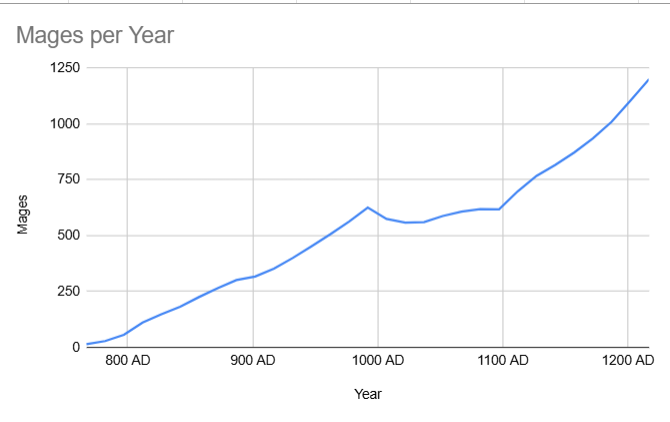
Tangential, but I was curious about this. I started with 14 Magi and started plugging in numbers for order size increase per 15 years until I got to ~1200 in 1220 AD. Factoring in the dying-off (or Twilight, retiring to become a monk, etc) folks, it’s around a change of 124% per 15 years (or x1.24), allowing for some wonky points (initial boom, the Schism War knocking out a bunch of mages, etc.). A total of 3566 mages over the course of the order, and 18 of those being MT hyperspecialists (based on your 0.5% approximation). Without knowing how much bad the Schism War was, it’s hard to really guess where the numbers are, but a few variations kept me in that “a little over 3000 total” range.
This is only slightly better than Back of an Envelope math, but maybe someone will find it useful OR will be inspired to do better math than me.