The Fourth Estate

I have some questions of a sociological nature regarding how the Order fits in with feudal society.

Much has been examined in Transforming Mythic Europe and I particularly like the Order becoming the fourth estate; that option aside, I am curious as to why the order has not taken over society ? They have the power to do so & most mundanes have no magic resistance. As I understand it, only areas possess Divine Auras that interfere with hermetic magic but surely not enough to block spells ? If the Church has the Divine power of God, why have they not instigated a crusade against the order ? Does the Church not teach that magic is from the devil ?

I am having a hard time accepting that the magi just want to be left alone to create spells, items and conduct research. Magi are still human and are surely susceptible to power and corruption ? Is it just the threat of Marches that keep Magi from taking over the nobility and church ?

In the case of the fourth estate, surely nobility would engage magi for a huge variety of services : war magic, debilitating rivals, healthy abundant harvests, tracing bloodlines, ensuring healthy robust heirs.

To be clear I absolutely love AM but it's the societal aspects that I'm struggling with.

Any insight would be appreciated

Look at ArMDE p.203ff The Gift. Unless a maga has the Major Virtue Gentle Gift (like many Jerbitons have), she makes a lousy leader of people not under the Parma Magica.
As for Jerbitons, these are watched closely by their sodales: meddling with mundanes is an Hermetic crime especially made for magi with the Gentle Gift, so these don't harass their sodales employing mundane masses.

No. It is the threat of poison, an assassin, etc.

The Gift social penalty, I believe is meant to be more brutal that it is often played. Some see it as just a - 3.

A result of a 6 for a social roll gets the usual response for that kind of social encounter. A barkeep wants custom, so he will be cheerful on a 6; a guard seeing someone who is not meant to be there, the 6 reaction is considering attacking, but will give a moment for an explanation.

A certain interpretation of RAW considers it differently. The default reaction for a 6 result is worse for magi. The barkeep will still serve them, but put them in the corner, the guard will immediately attack. So the 9 roll adjusted to a 6, is tough.

Under that interpretation, any but a gently gifted mage can expect non-stop assassins, poison, etc. They will be despised.

At least some of the order, it's not concern about the Church's action, it is concern about God's action if they go too far.

why the order has not taken over society yet is a big part of it. It's worth noting that the order (at assumed game-start, 1220 AD) has just barely finished up a century of watchful peace, the first time since its foundation that there hasn't been some huge calamity (like the Spider War or the Schism War) taking up everyone's time and attention and depleting the mages' numbers. The 13th century is the first century in which mages could consider taking over Europe. However, up until now that would almost certainly have failed, and possibly led to the church declaring a holy war or all the nobles starting trouble. Hence the fairly strict rules about not interfering with Mundanes, and the social framework around that. In order to take over Europe, you'd have to either

  • Convince the Order to move that direction, which some are already working on but would probably take another 100 years or so of Grand Tribunals to agree to it and then begin implementing it

OR

  • Stealthily convince at least two dozen if not more wizards of archmage level to all basically-simultaneously take over different countries across Europe, with such efficiency and authority that there'd be no one in the order with the might to challenge you about it. If you only did so in, say, Iberia, every other tribunal would come for your head for breaking the code, and do so without anyone finding out and trying to stop you. Such a Cabal COULD exist, especially if they did something so calamitous that it would shift the balance of power. cf. Dies Irae for an example of Criamon doing that.

HOWEVER

Now that there's been a century of peace, and there are more and more mages every day, the time at which the scales tip enough that there are enough breakthroughs and stored-up power and resources to make a takeover of Europe draws closer and closer every day. And all it would take would be a massive amount of devastation to create power vacuums into which mages could step. Something like, I don't know, a plague. A really big one.

I do also think there's a Vis component - right now, there's about enough Vis for the covenants that exist to bask in the creature comforts and whatever powerful enchantments and rituals they enjoy. If Mages were suddenly on the hook for vast swathes of Europe, they'd be burning through way more Vis to keep up with the amount of work required to stabilize this new society. And if more people knew how Vis worked, there might be more competition for, and endangerment of, vis sites.

It's why I think the various Vis creation/extraction breakthroughs are the thing that would allow for Transforming Mythic Europe to really happen. We already know that there's ways to intentionally grow Animal and Herbam vis, in a scalable operation, and extracting Aquam, Auram, Ignam, Terram, and Vim vis is already doable. If the last three forms are unlocked, in a way that is repeatable and doesn't require hyper-specific locations, it would be enough of a game changer to make running Mythic Europe much more viable.

Your question is a great one. It’s asked and answered on page 497 of the Definitive Edition. This is the first pargraph. It’s an out-of-character answer but truthful. See the paragraphs that follow for in-character answers that try to explain this simple truth:

Not only is it hard work and dangerous but the Order is self-policing. House Tremere might want to rule Europe, but they like the current setup better than having House Merinita in charge. And so on.

If the Order did take over Europe, the next order of business would be a full scale civil war of Wizard Wars over what to do with it. Fatalities all over the place.

No, the Church does not teach this.

The real-world medieval Church had a lot of different writers putting forward different opinions on "witchcraft", "divination", "natural magic", and related maters. And none of the categories these various theologians invented maps well to Hermetic magic.

Given that, the game could have gone ahead and specified a universal reaction of the Church to Hermetic magic, but it has chosen not to.

Different sagas, different answers.

I lean toward magi not taking over Europe because they generally don't need to. A king or a coalition of kings, a widespread crusade, or similar would be a threat, but not necessarily an overwhelming one.

Magi can create gold from nothing, animate the dead, and ruin the land, if they want to. Most want to pursue their various interests. Some may want mundane power, but most don't, and if that mage overtly seeks rule, they're causing headaches.

Also, ruling over mortals is not interesting. Kings, nobles, and knights want land and taxes to varying scales. The Church wants that too, and is happy to not have land to get income. Peasants want food, shelter, and to be left to themselves. Town commoners want income.

Magi want vis, insight, and knowledge, to varying ends, most of which need mundane concerns and petty power only as tools.

My go-to solution is that most magi are essentially mystics, seeking to deepen their understanding of magic (the Arts, and for some Mysteries), or pursue esoteric ends such as tending a magical garden. Couple that with their low numbers, especially in the past, and the Order's ability to reshape Europe suddenly seems far weaker.

The Order's internal wars certainly don't help either.

And there is also the idea that mundane interference is frowned upon. I don't think the Order's history does a good job of showing that, however. It should have included at least one major event in the Order's early history that showcases just how bad mundane interference can be.

It's a mix of not needing to rule Europe (when you can create a room full of gold - do you need taxes?), the headache of the Gift for non-Gentle Gifted, a fairly high number of mages who actually prefer not to leave their labs if they can help it - and who frown on people who cause trouble that will make them leave your lab. Nobody cares if you kill a noble and don't get caught - but if you threaten the local Count and he shows up at your covenant to siege you, your covenant mates tend to frown on that. And if you have your covenant mates on board, you might not stop at the count and then decide to topple the local duke. By doing so, you've got the gaze of the entire nobility, and you've attracted the attention of tribunal political magi who don't really want someone able to call on a thousand men at arms in a conflict that could otherwise be resolved by certamen.

It should have included at least one major event in the Order's early history that showcases just how bad mundane interference can be.

This is a fun idea, although I'm not sure how you would do so in a way that doesn't cause Ripple Effects across all of history, and that wouldn't create great enmity between The Order and some Nobility. suppose there's probably some part of history where we just don't know that much about that time period in that place so it's a bit of a sandbox, but I don't know enough history (off the top of my head (past my bed time)) to know what that time/place would be.

Would love to hear ideas for what people would insert as the hypothetical "The Gang Interferes With The Mundanes" canon event.

Perhaps the Gothic Wars?

AI generated example:

The War of the Seven Colleges

Later Hermetic scholars agreed that no disaster before the Schism War inflicted such lasting ruin upon European magic as the Gothic War. The Roman magical traditions, once united in reverence for Mercury and the ancient rites of the Empire, had long since fractured into rival colleges. When Belisarius crossed into Italy, those rivalries became open war.

The Collegium Ravennatis proclaimed that Justinian had been chosen by Providence to restore the Empire, and lent invisible aid to the imperial armies. Against them stood the old senatorial circles of Rome, together with the Gothic augurs and Etruscan haruspices, who judged the Ostrogothic kingdom to be the last lawful heir of Rome. Others remained neutral only briefly before being drawn into the struggle by old feuds or desperate alliances. Before long every siege concealed another siege, every battle another battle, unseen by mundane eyes.

The chroniclers record only strange fortune. Belisarius repeatedly escaped destruction through decisions that even his own officers considered inexplicable. Totila's armies marched through provinces where resistance seemed to melt away overnight. Sibyls, prophets and visionaries appeared in every camp. Neither side suspected how many of these were merely the shadows cast by the hidden war.

As the years passed, restraint vanished. Rituals once reserved for the greatest festivals of Mercury were turned to war. Rivers were cursed to flood the lands of enemies. Harvests withered beneath invisible maledictions. Ancient guardian spirits were bound into military service. Regiones were forced open to shelter refugees or conceal armies, and many never closed again. Quaesitorial tradition maintains that several of the enduring magical wastelands of Italy date from these workings, though the mundanes remembered only famine.

Procopius wrote simply that "the country lay everywhere deserted" and that the plague came when "the whole human race came near to being annihilated." He tells of burial rites abandoned, cities emptied, and whole districts falling silent. He even records that "apparitions of supernatural beings in human guise were seen by many persons," and that those who encountered them immediately sickened. To the learned of later centuries these words were no mere superstition. They were the testimony of a man who witnessed the invisible war without possessing the language to describe it.

Then came the plague.

The survivors always insisted that it was not summoned by magic. Yet the magical war had already stretched the fabric separating the Realms. Thousands died each day without burial. Ghosts wandered leaderless through deserted streets. Covenants that had stood since the days of Augustus found themselves surrounded not by enemies but by the restless dead. Divine miracles multiplied in answer to desperate prayers. Infernal spirits fed upon despair, appearing in visions throughout Italy and whispering that the world itself had entered its final days. Even Procopius, no credulous monk but an imperial secretary, preserved the reports of supernatural visitants walking openly among the dying.

It was afterwards said that Justinian himself had become the prize in a contest among powers greater than men. Procopius dared write that the Emperor was "a demon in human form," recounting tales that his head vanished from his shoulders, that his face dissolved into a featureless void, and that a holy monk fled the imperial throne, declaring that he had seen not an emperor but the Chief of Demons seated there. Whether these were merely the ravings of a bitter historian or distorted memories of infernal meddling has never been settled among Hermetic scholars.

When at last the Lombards descended into Italy, there was scarcely anyone left to oppose them. The seven colleges had annihilated one another. Their libraries burned with the cities they had sworn to protect. Their apprentices had perished in plague. Their sanctuaries stood abandoned amid wilderness where wolves nested in former vineyards. Of the hundreds of Roman magi believed to have lived at the opening of Justinian's reign, later Bonisagus could discover only a handful of broken survivors, each guarding a few fragments of a tradition no longer whole.

Thus, say the oldest Quaesitorial commentaries, did the Roman magical world perish—not because mundane armies proved stronger than wizards, but because the magi chose to make the fate of kingdoms their own. When the kingdoms fell, so too did every covenant that had bound its destiny to crown or empire. Bonisagus and Trianoma needed no better lesson when they wrote that a magus must not interfere with the affairs of mundanes, lest the ruin of the mundanes become the ruin of all magi.
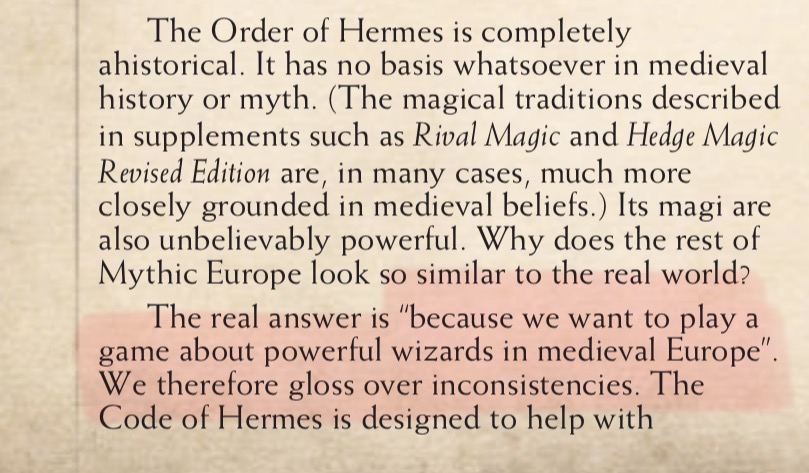
The setting is supposed to allow you to suspend disbelief over magi not having transformed Europe yet (so that you can play powerful wizards in medieval Europe), while not making it impossible for the player characters to do that (see Transforming Mythic Europe).

The second part of that means that there cannot be anything in the setting making it clearly inevitable that Europe turned out the way it did, which is why there is this sense that magi surely could have made a difference.

What is there is far more subtle.

The League of Iconophiles (HoH:S p.40) could control politics in Constantinople - but in the end not prevent the fall of the city to crusaders. Currently Jerbitons via the Coenobium (F&F p.128ff) control the Provence and try to make better.
Both major operations of "meddling with mundanes" keep history intact and thus avoid the need for clumsy and hard to sell sourcebooks about changes of history in Europe.

The hugest continuing operation of "meddling with mundanes" - and so far successful - is the entire Transylvanian Tribunal (AtD). Here the Order is limited to contain House Tremere and that Tribunal, after magi stealthily - and quite against the Code - brainwiped all of Tremere's lieutenants in 848 and narrowly avoided the founder's takeover of the Order. So the Transsylvanian Tribunal is a reminder to many magi, what a further successful takeover of the mundanes in a Tribunal by a cabal of magi could do the Order.

The attempt to found the Lotharingian Tribunal (GotF p.29) to benefit from more interaction with mundanes in the budding cities in the Low Counties keeps the Order busy, pondering the replacement of the blunt anathema of "meddling with mundanes" with more subtle means.
And yes, Tremere might actually become allies to Jerbitons about that matter.